# Images in physical space in Python
**URL:** https://discourse.itk.org/t/images-in-physical-space-in-python/2124
**Category:** Engineering
**Tags:** python
**Created:** [August 5, 2019, 6:16pm UTC](https://discourse.itk.org/t/images-in-physical-space-in-python/2124 "2019-08-05T18:16:33Z")
**Posts on this page:** 16
**Page:** 2
### Author:  [@matt.mccormick](https://discourse.itk.org/u/matt.mccormick)
#### Post date: [August 14, 2019, 9:26pm UTC](https://discourse.itk.org/t/images-in-physical-space-in-python/2124/21 "2019-08-14T21:26:43Z")
> [@blowekamp](#):
>
> It would be great if these libraries define the attributes the same way so they are interoperable.
Yes, lessons from the past emphasize the need for explicit, specific definitions.
To take another pass, and borrow from the ITK Software Guide:
- **`origin`** : N-dimensional sequence of floating-point values that specifies the location of the center of the 0-indexed pixel.
- **`spacing`** : N-dimensional sequence of floating-point values that specifies the physical distance between pixel centers in each direction.
- **`direction`** : NxN matrix of floating-point values that specifies the orientation of the image. Columns of the matrix are orthonormal direction cosines. For medical images, _direction_ corresponds to an _LPS_ (DICOM) coordinate system, i.e. the right-to-left, anterior-to-posterior, inferior-to-superior directions of the imaged person.
For a given index \vec{I} in 3D, the physical location \vec{P} is calculated as:
\begin{equation} \begin{pmatrix} P\_1\\\ P\_2\\\ P\_3 \end{pmatrix} = \begin{pmatrix} O\_1\\\ O\_2\\\ O\_3 \end{pmatrix} + \begin{pmatrix} D\_{1,1} & D\_{1,2} & D\_{1,3}\\\ D\_{2,1} & D\_{2,2} & D\_{2,3}\\\ D\_{3,1} & D\_{3,2} & D\_{3,3} \end{pmatrix} \* \begin{pmatrix} S\_1 & 0 & 0 \\\ 0 & S\_2 & 0 \\\ 0 & 0 & S\_3 \end{pmatrix} \* \begin{pmatrix} I\_1\\\ I\_2\\\ I\_3 \end{pmatrix} \end{equation}
Where:
- \vec{I}: pixel space index.
- \vec{P}: resulting physical space position of the image index \vec{I}.
- \vec{O}, _origin_: physical space origin of the first image index.
- \mathcal{D}, _direction_: direction cosines matrix (orthonormal). It represents the orientation relationship between the image and the physical space coordinate system.
- \vec{S}, _spacing_: physical spacing between pixels of the same axis.
---
### Author:  [@matt.mccormick](https://discourse.itk.org/u/matt.mccormick)
#### Post date: [August 14, 2019, 9:36pm UTC](https://discourse.itk.org/t/images-in-physical-space-in-python/2124/22 "2019-08-14T21:36:58Z")
> [@ctrueden](#):
>
> Would it then make sense to create some validation code, which implementors can use to check their image objects for appropriate structure?
Good point. We can create a reference, pure NumPy-based implementation, create tests for the attributes and methods. We can also provide those tests in a way that any implementation that wants to be spatial-image-array-like duck can test if its interface quacks like a spatial-image-array-like duck. 🦆 🎤
> [@ctrueden](#):
>
> If so, where would it live? Should it be part of scipy? Who do we invite to the conversation? Or file an issue on GitHub, perhaps?
Perhaps we should create an independent package for now, e.g. `spatialimage`. This package could only depend on `numpy`, so it is lightweight dependency. We can move rapidly – after it matures, it could move to a different home.
---
### Author:  [@blowekamp](https://discourse.itk.org/u/blowekamp)
#### Post date: [August 15, 2019, 1:50am UTC](https://discourse.itk.org/t/images-in-physical-space-in-python/2124/23 "2019-08-15T01:50:53Z")
@matt.mccormick That is looking like a good start.
There was a [recent discussion](https://discourse.itk.org/t/making-a-3d-sequence-from-4d-volume/2070) of how to handle time. Similarly there are a couple different ways to order color. i.e. CXYZ, XYZTC etc. Simularly tensor images too. How can non-physical dimensions be handled? ITK uses a templated pixel type to separate a physical dimension form “pixel components”
There is also the definition and order of an “index”. We mean `(i,j,k)` where i is the fasted changing index, but then `ndarrays` are indexed via `[k,j,i]`.
I expect others from different domains will have additional concerns and comments to improve the specification too. It may be worthwhile to go through a more formal proposal and comment process to aid in getting more eyes on the spec, and interest.
Would the `LPS` direction imply that 2-D it just `LP` with the origin being in the top right?
---
### Author:  [@lassoan](https://discourse.itk.org/u/lassoan)
#### Post date: [August 15, 2019, 2:30am UTC](https://discourse.itk.org/t/images-in-physical-space-in-python/2124/24 "2019-08-15T02:30:21Z")
> [@blowekamp](#):
>
> It may be worth wild to go through a more formal proposal and comment process to aid in getting more eyes on the spec, and interest.
Fully agree.
> [@blowekamp](#):
>
> Would the `LPS` direction imply that 2-D it just `LP` with the origin being in the top right?
In most medical imaging applications, 2D images are still 3D images (just happen to have a single slice), with their position, spacing (pixel size and slice thickness), and axis directions defined in 3D space. In these images, axes would be still LPS.
If the 2D image is not defined in 3D space (microscopy, optical camera, etc.) then I don’t think LPS coordinate system would be applicable.
---
### Author:  [@matt.mccormick](https://discourse.itk.org/u/matt.mccormick)
#### Post date: [August 15, 2019, 2:34am UTC](https://discourse.itk.org/t/images-in-physical-space-in-python/2124/25 "2019-08-15T02:34:08Z")
> [@blowekamp](#):
>
> There was a [recent discussion](https://discourse.itk.org/t/making-a-3d-sequence-from-4d-volume/2070) of how to handle time. Similarly there are a couple different ways to order color. i.e. CXYZ, XYZTC etc.
> [@blowekamp](#):
>
> There is also the definition and order of an “index”. We mean `(i,j,k)` where i is the fasted changing index, but then `ndarrays` are indexed via `[k,j,i]` .
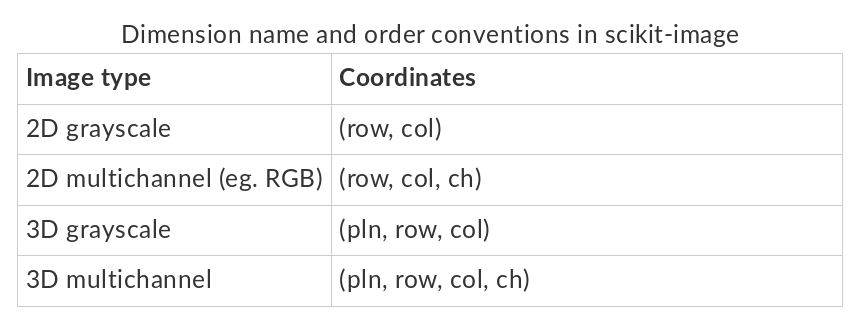
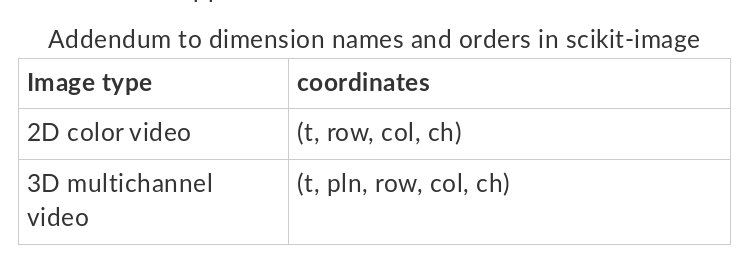
It is reasonable to apply [the conventions of scikit-image](https://scikit-image.org/docs/stable/user_guide/numpy_images.html) for indexing, space, channel, and time order. These are compatible with how data is natively organized in ITK and NumPy array interfaces to `itk.Image`. That is, `[k,j,i]` indexing,
> [@blowekamp](#):
>
> I expect others from different domains will have additional concerns and comments to improve the specification too.
We can add documentation to a repository and use pull requests and line-based comments for additional discussion.
---
### Author:  [@jni](https://discourse.itk.org/u/jni)
#### Post date: [August 17, 2019, 8:22am UTC](https://discourse.itk.org/t/images-in-physical-space-in-python/2124/26 "2019-08-17T08:22:29Z")
> [@matt.mccormick](#):
>
> We can create a reference, pure NumPy-based implementation, create tests for the attributes and methods.
To reiterate, I really think it might be better to build a spec on top of xarray rather than numpy. They exactly solve the problem of “arrays with annotations”, and we can leverage their extensive efforts to provide compatibility with dask, distributed computing, etc. Matt Rocklin specifically pulled me aside at SciPy to implore me to look long and hard at xarray, which he considers to be ready for production, before developing our own metadata handling at scikit-image.
---
### Author:  [@pieper](https://discourse.itk.org/u/pieper)
#### Post date: [June 21, 2024, 8:38pm UTC](https://discourse.itk.org/t/images-in-physical-space-in-python/2124/27 "2024-06-21T20:38:50Z")
Hi @matt.mccormick @lassoan @blowekamp @matthew.brett and all! Did any of this end up happening?
I’ve been trying to dig up any conventions about how to put physical space info into zarr but have only found discussions but no conclusions…
---
### Author:  [@jni](https://discourse.itk.org/u/jni)
#### Post date: [June 22, 2024, 12:45am UTC](https://discourse.itk.org/t/images-in-physical-space-in-python/2124/28 "2024-06-22T00:45:25Z")
Nothing too definitive I’m afraid but:
- xarray are now working on a more minimal [NamedArray](https://github.com/pydata/xarray/discussions/8080) object that might be suitable.
- if you only need (a subset of) the named axes tczyx and scale and translation information, [ome-zarr/ome-ngff v0.4](https://ngff.openmicroscopy.org/0.4/index.html) allows you to store this metadata with a zarr array, and there is good support for reading that metadata in many languages.
- in the context of ome-zarr, if you need more sophisticated transforms, you will have to wait a couple of versions I’m afraid — see my [RFC-3](https://github.com/ome/ngff/pull/239) and the currently stalled but imho close-to-final [transformations specification PR](https://github.com/ome/ngff/pull/138).
---
### Author:  [@pieper](https://discourse.itk.org/u/pieper)
#### Post date: [June 22, 2024, 9:15pm UTC](https://discourse.itk.org/t/images-in-physical-space-in-python/2124/29 "2024-06-22T21:15:24Z")
Thanks for the update and links @jnl 👍
---
### Author:  [@matt.mccormick](https://discourse.itk.org/u/matt.mccormick)
#### Post date: [July 23, 2024, 3:05am UTC](https://discourse.itk.org/t/images-in-physical-space-in-python/2124/30 "2024-07-23T03:05:51Z")
> [@pieper](#):
>
> physical space info into zarr but have only found discussions but no conclusions…
Here are few examples! 🌞
They,
1. Generate correct _scales_ and _translations_, aka as _spacing_ and _origin_ in ITK lingo, which are included in v0.4 of the OME-Zarr specification. This includes correct values for the multiple scales.
2. Generate the multiscale representation for the first and second library
3. Can be used in memory in Python or to convert files from ITK and non-ITK-based IO libraries, [tifffile](https://pypi.org/project/tifffile/), [imageio](https://pypi.org/project/imageio/), or [pyimagej](https://pypi.org/project/pyimagej/), preserving or adding spatial metadata as needed.
* * *
## [ngff-zarr](https://ngff-zarr.readthedocs.io/en/latest/)
### ✨ Features
- Minimal dependencies
- Work with arbitrary Zarr store types
- Lazy, parallel, and web ready – no local filesystem required
- Process extremely large datasets
- Multiple downscaling methods
- Supports Python\>=3.8
- Implements version 0.4 of the
[OME-Zarr NGFF specification](https://github.com/ome/ngff)
### Installation
To install the command line interface (CLI):
```shell
pip install 'ngff-zarr[cli]'
```
CLI example:
```shell
ngff-zarr -i ./MR-head.nrrd -o ./MR-head.ome.zarr
```
Bidirectional type conversion that preserves spatial metadata is available with
`itk_image_to_ngff_image` and `ngff_image_to_itk_image`.
Once represented as an `NgffImage`, a multiscale representation can be generated
with `to_multiscales`. And an OME-Zarr can be generated from the multiscales
with `to_ngff_zarr`.
### ITK Python
An example with
[ITK Python](https://docs.itk.org/en/latest/learn/python_quick_start.html):
```python
>>> import itk
>>> import ngff_zarr as nz
>>>
>>> itk_image = itk.imread('cthead1.png')
>>>
>>> ngff_image = nz.itk_image_to_ngff_image(itk_image)
>>>
>>> # Back again
>>> itk_image = nz.ngff_image_to_itk_image(ngff_image)
```
### ITK-Wasm Python
An example with [ITK-Wasm](https://wasm.itk.org). ITK-Wasm’s `Image` is a simple
Python dataclass like `NgffImage`.
```python
>>> from itkwasm_image_io import imread
>>> import ngff_zarr as nz
>>>
>>> itk_wasm_image = imread('cthead1.png')
>>>
>>> ngff_image = nz.itk_image_to_ngff_image(itk_wasm_image)
>>>
>>> # Back again
>>> itk_wasm_image = nz.ngff_image_to_itk_image(ngff_image, wasm=True)
```
### Python Array API
NGFF-Zarr supports conversion of any NumPy array-like object that follows the
[Python Array API Standard](https://data-apis.org/array-api/latest/) into
OME-Zarr. This includes such objects an NumPy `ndarray`’s, Dask Arrays, PyTorch
Tensors, CuPy arrays, Zarr array, etc.
#### Array to NGFF Image
Convert the array to an `NgffImage`, which is a standard
[Python dataclass](https://docs.python.org/3/library/dataclasses.html) that
represents an OME-Zarr image for a single scale.
When creating the image from the array, you can specify
- names of the `dims` from `{‘t’, ‘z’, ‘y’, ‘x’, ‘c’}`
- the `scale`, the pixel spacing for the spatial dims
- the `translation`, the origin or offset of the center of the first pixel
- a `name` for the image
- and `axes_units` with
[UDUNITS-2 identifiers](https://ngff.openmicroscopy.org/latest/#axes-md)
```python
>>> # Load an image as a NumPy array
>>> from imageio.v3 import imread
>>> data = imread('cthead1.png')
>>> print(type(data))
```
Specify optional additional metadata with `to_ngff_zarr`.
```python
>>> import ngff_zarr as nz
>>> image = nz.to_ngff_image(data,
dims=['y', 'x'],
scale={'y': 1.0, 'x': 1.0},
translation={'y': 0.0, 'x': 0.0})
>>> print(image)
NgffImage(
data=dask.array,
dims=['y', 'x'],
scale={'y': 1.0, 'x': 1.0},
translation={'y': 0.0, 'x': 0.0},
name='image',
axes_units=None,
computed_callbacks=[]
)
```
The image data is nested in a lazy `dask.array` and chucked.
If `dims`, `scale`, or `translation` are not specified, NumPy-compatible
defaults are used.
#### Generate multiscales
OME-Zarr represents images in a chunked, multiscale data structure. Use
`to_multiscales` to build a task graph that will produce a chunked, multiscale
image pyramid. `to_multiscales` has optional `scale_factors` and `chunks`
parameters. An antialiasing method can also be prescribed.
```python
>>> multiscales = nz.to_multiscales(image,
scale_factors=[2,4],
chunks=64)
>>> print(multiscales)
Multiscales(
images=[
NgffImage(
data=dask.array,
dims=['y', 'x'],
scale={'y': 1.0, 'x': 1.0},
translation={'y': 0.0, 'x': 0.0},
name='image',
axes_units=None,
computed_callbacks=[]
),
NgffImage(
data=dask.array,
dims=['y', 'x'],
scale={'x': 2.0, 'y': 2.0},
translation={'x': 0.5, 'y': 0.5},
name='image',
axes_units=None,
computed_callbacks=[]
),
NgffImage(
data=dask.array,
dims=['y', 'x'],
scale={'x': 4.0, 'y': 4.0},
translation={'x': 1.5, 'y': 1.5},
name='image',
axes_units=None,
computed_callbacks=[]
)
],
metadata=Metadata(
axes=[
Axis(name='y', type='space', unit=None),
Axis(name='x', type='space', unit=None)
],
datasets=[
Dataset(
path='scale0/image',
coordinateTransformations=[
Scale(scale=[1.0, 1.0], type='scale'),
Translation(
translation=[0.0, 0.0],
type='translation'
)
]
),
Dataset(
path='scale1/image',
coordinateTransformations=[
Scale(scale=[2.0, 2.0], type='scale'),
Translation(
translation=[0.5, 0.5],
type='translation'
)
]
),
Dataset(
path='scale2/image',
coordinateTransformations=[
Scale(scale=[4.0, 4.0], type='scale'),
Translation(
translation=[1.5, 1.5],
type='translation'
)
]
)
],
coordinateTransformations=None,
name='image',
version='0.4'
),
scale_factors=[2, 4],
method=,
chunks={'y': 64, 'x': 64}
)
```
The `Multiscales` dataclass stores all the images and their metadata for each scale according the OME-Zarr data model. Note that the correct `scale` and `translation` for each scale are automatically computed.
#### Write to Zarr
To write the multiscales to Zarr, use `to_ngff_zarr`.
```python
nz.to_ngff_zarr('cthead1.ome.zarr', multiscales)
```
Use the `.ome.zarr` extension for local directory stores by convention.
Any other [Zarr store type](https://zarr.readthedocs.io/en/stable/api/storage.html) can also be used.
The multiscales will be computed and written out-of-core, limiting memory usage.
* * *
## [multiscale-spatial-image](https://github.com/spatial-image/multiscale-spatial-image)
enerate a multiscale, chunked, multi-dimensional spatial image data structure
that can serialized to [OME-NGFF](https://ngff.openmicroscopy.org/).
Each scale is a scientific Python [Xarray](https://xarray.pydata.org/en/stable/) [spatial-image](https://github.com/spatial-image/spatial-image) [Dataset](https://docs.xarray.dev/en/stable/generated/xarray.Dataset.html), organized
into nodes of an Xarray [Datatree](https://xarray-datatree.readthedocs.io/en/latest/).
## Installation
```sh
pip install multiscale_spatial_image
```
### Usage
```python
import numpy as np
from spatial_image import to_spatial_image
from multiscale_spatial_image import to_multiscale
import zarr
# Image pixels
array = np.random.randint(0, 256, size=(128,128), dtype=np.uint8)
image = to_spatial_image(array)
print(image)
```
An [Xarray](https://xarray.pydata.org/en/stable/) [spatial-image](https://github.com/spatial-image/spatial-image) [DataArray](https://xarray.pydata.org/en/stable/generated/xarray.DataArray.html). Spatial metadata can also be passed
during construction.
```auto
array([[114, 47, 215, ..., 245, 14, 175],
[94, 186, 112, ..., 42, 96, 30],
[133, 170, 193, ..., 176, 47, 8],
...,
[202, 218, 237, ..., 19, 108, 135],
[99, 94, 207, ..., 233, 83, 112],
[157, 110, 186, ..., 142, 153, 42]], dtype=uint8)
Coordinates:
* y (y) float64 0.0 1.0 2.0 3.0 4.0 ... 123.0 124.0 125.0 126.0 127.0
* x (x) float64 0.0 1.0 2.0 3.0 4.0 ... 123.0 124.0 125.0 126.0 127.0
```
```python
# Create multiscale pyramid, downscaling by a factor of 2, then 4
multiscale = to_multiscale(image, [2, 4])
print(multiscale)
```
A chunked [Dask](https://docs.dask.org/en/stable/array.html) Array MultiscaleSpatialImage [Xarray](https://xarray.pydata.org/en/stable/) [Datatree](https://xarray-datatree.readthedocs.io/en/latest/).
```auto
DataTree('multiscales', parent=None)
├── DataTree('scale0')
│ Dimensions: (y: 128, x: 128)
│ Coordinates:
│ * y (y) float64 0.0 1.0 2.0 3.0 4.0 ... 123.0 124.0 125.0 126.0 127.0
│ * x (x) float64 0.0 1.0 2.0 3.0 4.0 ... 123.0 124.0 125.0 126.0 127.0
│ Data variables:
│ image (y, x) uint8 dask.array
├── DataTree('scale1')
│ Dimensions: (y: 64, x: 64)
│ Coordinates:
│ * y (y) float64 0.5 2.5 4.5 6.5 8.5 ... 118.5 120.5 122.5 124.5 126.5
│ * x (x) float64 0.5 2.5 4.5 6.5 8.5 ... 118.5 120.5 122.5 124.5 126.5
│ Data variables:
│ image (y, x) uint8 dask.array
└── DataTree('scale2')
Dimensions: (y: 16, x: 16)
Coordinates:
* y (y) float64 3.5 11.5 19.5 27.5 35.5 ... 91.5 99.5 107.5 115.5 123.5
* x (x) float64 3.5 11.5 19.5 27.5 35.5 ... 91.5 99.5 107.5 115.5 123.5
Data variables:
image (y, x) uint8 dask.array
```
Store as an Open Microscopy Environment-Next Generation File Format ([OME-NGFF](https://ngff.openmicroscopy.org/))
/ [netCDF](https://www.unidata.ucar.edu/software/netcdf/) [Zarr](https://zarr.readthedocs.io/en/stable/) store.
It is highly recommended to use `dimension_separator='/'` in the construction of
the Zarr stores.
```python
store = zarr.storage.DirectoryStore('multiscale.zarr', dimension_separator='/')
multiscale.to_zarr(store)
```
- A more detailed ITK-based example: [](https://mybinder.org/v2/gh/spatial-image/multiscale-spatial-image/main?urlpath=lab/tree/examples%2FConvertITKImage.ipynb)
* * *
## [ITKIOOMEZarrNGFF](https://github.com/InsightSoftwareConsortium/ITKIOOMEZarrNGFF)
This is a wrapper around a pure C++ core.
### Installation
```shell
pip install itk-ioomezarrngff
```
### Example
```python
import itk
image = itk.imread('cthead1.png')
itk.imwrite(image, 'ctheaed1.ome.zarr')
```
* * *
> in the context of ome-zarr, if you need more sophisticated transforms, you will have to wait a couple of versions I’m afraid — see my RFC-3 1 and the currently stalled but imho close-to-final transformations specification PR.
We will continue to hack on [OME-Zarr Coordinate Transformations this weekend](https://insightsoftwareconsortium.github.io/GetYourBrainTogether/HCK03_2024_UNC_Hybrid/) – please join us!
---
### Author:  [@pieper](https://discourse.itk.org/u/pieper)
#### Post date: [July 23, 2024, 5:32am UTC](https://discourse.itk.org/t/images-in-physical-space-in-python/2124/31 "2024-07-23T05:32:50Z")
Thanks @matt.mccormick - these are great references!
I’ve [spent some time investigating](https://projectweek.na-mic.org/PW41_2024_MIT/Projects/MorphodepotCollaborativeSegmentationProjects/#progress-and-next-steps) them and find the whole ecosystem quite impressive 👍
But here’s the rub:
> [@matt.mccormick](#):
>
> _scales_ and _translations_, aka as _spacing_ and _origin_ in ITK lingo
What about _directions_? I.e. the concept represented by [ImageOrientationPatient](https://dicom.innolitics.com/ciods/rt-dose/image-plane/00200037) in DICOM or _[space directions](https://teem.sourceforge.net/nrrd/format.html#spacedirections)_ in nrrd?
Support for directions in ITK was a huge step forward back in the day, and I think it’s equally important to have it as a first class property of the zarr/ngff world if it’s going to be workable for medical imaging in addition to microscopy.
I won’t be able to join the hackathon, but look forward to catching up on this next month - have fun hacking!
---
### Author:  [@matt.mccormick](https://discourse.itk.org/u/matt.mccormick)
#### Post date: [July 23, 2024, 3:00pm UTC](https://discourse.itk.org/t/images-in-physical-space-in-python/2124/32 "2024-07-23T15:00:08Z")
> [@pieper](#):
>
> What about _directions_? I.e. the concept represented by [ImageOrientationPatient](https://dicom.innolitics.com/ciods/rt-dose/image-plane/00200037) in DICOM or _[space directions](https://teem.sourceforge.net/nrrd/format.html#spacedirections)_ in nrrd?
>
> Support for directions in ITK was a huge step forward back in the day, and I think it’s equally important to have it as a first class property of the zarr/ngff world if it’s going to be workable for medical imaging in addition to microscopy.
@pieper yes you are absolutely right – _directions_ are quite important, especially for medical imaging datasets.
Those tools I referenced do have some ad-hoc support for direction information, but it is not yet in the standard and not supported by the broader ecosystem, which is quite large at this point. And the hackathon aims to make progress in this area. Bummer that you will not be able to make the hackathon, but the community effort will certainly continue past the event, and I look forward to your participation! 🙌
---
### Author:  [@lassoan](https://discourse.itk.org/u/lassoan)
#### Post date: [July 23, 2024, 6:51pm UTC](https://discourse.itk.org/t/images-in-physical-space-in-python/2124/33 "2024-07-23T18:51:48Z")
> [@matt.mccormick](#):
>
> Those tools I referenced do have some ad-hoc support for direction information, but it is not yet in the standard and not supported by the broader ecosystem, which is quite large at this point
It is perfectly fine if most of the tools only know about voxel space. It is even understandable if some processing algorithms only need spacing information (e.g., to do some non-linear spatial filtering).
However, adding a physical image translation without specifying physical axis direction information just does not make any sense. Wherever support for translation is added, at the same place it has to be easy to use the direction information as well.
Adding support for origin and spacing without directions would make the situation much worse than not having any support for origin and spacing at all, because it makes it much harder to add direction support later, when there is already a half-baked solution for physical mapping and we need to worry about backward compatibility.
Is it too late to step in and either prevent adding support for scales and translation, or (preferably) add support for directions as well? I might be able to join the hackathon if that helps. When/where is it?
---
### Author:  [@blowekamp](https://discourse.itk.org/u/blowekamp)
#### Post date: [July 23, 2024, 6:57pm UTC](https://discourse.itk.org/t/images-in-physical-space-in-python/2124/34 "2024-07-23T18:57:44Z")
> [@lassoan](#):
>
> However, adding a physical image translation without specifying physical axis direction information just does not make any sense. Wherever support for translation is added, at the same place it has to be easy to use the direction information as well.
>
> Adding support for origin and spacing without directions would make the situation much worse than not having any support for origin and spacing at all, because it makes it much harder to add direction support later, when there is already a half-baked solution for physical mapping and we need to worry about backward compatibility.
>
> Is it too late to step in and either prevent adding support for scales and translation, or (preferably) add support for directions as well?
Translation and Scales are already in the specification:
[https://ngff.openmicroscopy.org/latest/index.html#trafo-md](https://ngff.openmicroscopy.org/latest/index.html#trafo-md)
---
### Author:  [@matt.mccormick](https://discourse.itk.org/u/matt.mccormick)
#### Post date: [July 23, 2024, 7:52pm UTC](https://discourse.itk.org/t/images-in-physical-space-in-python/2124/35 "2024-07-23T19:52:42Z")
Support for pixels, then spacing, then an origin, then direction is a common path to the functionality that is needed in many cases. While we enjoy the support ITK has had for decades for all of these things, we should recognize that ITK did not immediately have direction support either (it was [only in 2005 that support was added](https://web.archive.org/web/20050420010948/https://itk.org/Wiki/Proposals:Orientation) 🙂 ). We should recognize that:
- Support across open source tools, algorithms and standards is not going to be instantaneous, it will be a process.
- Support for origin and spacing without direction is better than no spatial metadata support.
> [@lassoan](#):
>
> Adding support for origin and spacing without directions would make the situation much worse than not having any support for origin and spacing at all, because it makes it much harder to add direction support later, when there is already a half-baked solution for physical mapping and we need to worry about backward compatibility.
I strongly disagree. Support for origin and spacing does not make it harder to add direction support. And the addition of direction support, when there was not direction support, is not a backwards compatibility issue. If direction information is needed, then it should have been pre-applied before inputting to a system that does not have direction support.
> [@lassoan](#):
>
> I might be able to join the hackathon if that helps. When/where is it?
@lassoan your participation is welcome. The [details are here](https://insightsoftwareconsortium.github.io/GetYourBrainTogether/HCK03_2024_UNC_Hybrid/).
---
### Author:  [@lassoan](https://discourse.itk.org/u/lassoan)
#### Post date: [July 23, 2024, 8:48pm UTC](https://discourse.itk.org/t/images-in-physical-space-in-python/2124/36 "2024-07-23T20:48:38Z")
I would prefer not to have incomplete/incorrect physical mapping implementation, because it would make it much harder for me to later find all the places where fixes are needed than implementing mapping everywhere with having image directions in mind. But maybe this is just a personal preference.
Anyway, hopefully implementations are still not that far ahead so that we can make corrections. We don’t need to add direction support at every levels (xarray, dask, …), but if we want NGFF to be directly usable for clinical imaging (without adapter libraries) then it must be able to specify linear mapping between image and physical space.
I’ll try to join the hackathon.
[Previous page](https://discourse.itk.org/t/images-in-physical-space-in-python/2124.md?page=1)