# Fully automated algorithm to detect MRI noise/artifact?
**URL:** https://discourse.itk.org/t/fully-automated-algorithm-to-detect-mri-noise-artifact/5973
**Category:** Algorithms
**Created:** [May 31, 2023, 2:38pm UTC](https://discourse.itk.org/t/fully-automated-algorithm-to-detect-mri-noise-artifact/5973 "2023-05-31T14:38:13Z")
**Posts on this page:** 3
**Page:** 1
### Author:  [@SteveRobbins](https://discourse.itk.org/u/SteveRobbins)
#### Post date: [May 31, 2023, 2:38pm UTC](https://discourse.itk.org/t/fully-automated-algorithm-to-detect-mri-noise-artifact/5973/1 "2023-05-31T14:38:13Z")
I want to detect a “noisy” or “artifact-impaired” MRI image – basically a way to classify the image as noisy or not. For clarity, a “good” image looks like the first one, whereas a “bad” image might look like one of the other two.
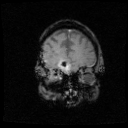 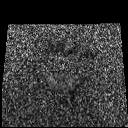 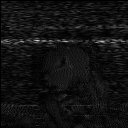
I have a hunch that a measure like Shannon Entropy might be able to distinguish these and I’m about to do that experiment on my datasets.
What I wanted to ask, is how do I find prior research on the topic of simple detection? I tried the obvious searches – MRI artifact detection / noise detection – and find most results are about motion artifact detection and removal. That is interesting, of course, but I haven’t found anything yet on simple detection of the kind of images shown above; I’m not attempting to “correct” for the noise, just detect it. Any thoughts on keywords to use?
---
### Author:  [@Stephen\_Aylward](https://discourse.itk.org/u/Stephen_Aylward)
#### Post date: [May 31, 2023, 3:03pm UTC](https://discourse.itk.org/t/fully-automated-algorithm-to-detect-mri-noise-artifact/5973/2 "2023-05-31T15:03:07Z")
Hi,
I am not certain of the capabilities / techniques involved, but a group at Kitware has been developing an open-source project the includes traditional and deep learning methods for MRI QC.
Perhaps it will help with code samples/methods to consider.
[https://miqa.kitware.com/](https://miqa.kitware.com/)
s
---
### Author:  [@dzenanz](https://discourse.itk.org/u/dzenanz)
#### Post date: [May 31, 2023, 3:09pm UTC](https://discourse.itk.org/t/fully-automated-algorithm-to-detect-mri-noise-artifact/5973/3 "2023-05-31T15:09:43Z")
We had a [short paper](https://openreview.net/pdf?id=dBxvjWJTVW-) last year about it. We have a [demo deployment](https://miqa.miqaweb.io/). I am not sure whether it is still fully functional.
You might want to take a look at signal to noise ratio (SNR) classic quality metric, links [here](https://github.com/OpenImaging/miqa/issues/133).