# Does non-rigid registration changes the real Geometry?
**URL:** https://discourse.itk.org/t/does-non-rigid-registration-changes-the-real-geometry/6359
**Category:** Beginner Questions
**Created:** [December 15, 2023, 9:32am UTC](https://discourse.itk.org/t/does-non-rigid-registration-changes-the-real-geometry/6359 "2023-12-15T09:32:44Z")
**Posts on this page:** 3
**Page:** 1
### Author:  [@Faramarz-bagherzadeh](https://discourse.itk.org/u/Faramarz-bagherzadeh)
#### Post date: [December 15, 2023, 9:32am UTC](https://discourse.itk.org/t/does-non-rigid-registration-changes-the-real-geometry/6359/1 "2023-12-15T09:32:44Z")
Hello all,
I have 2 sets of micro CT images (3D):
1. with the 12-micrometer resolution taken in Axial mode
2. with the 120-micrometer resolution taken in Helical mode
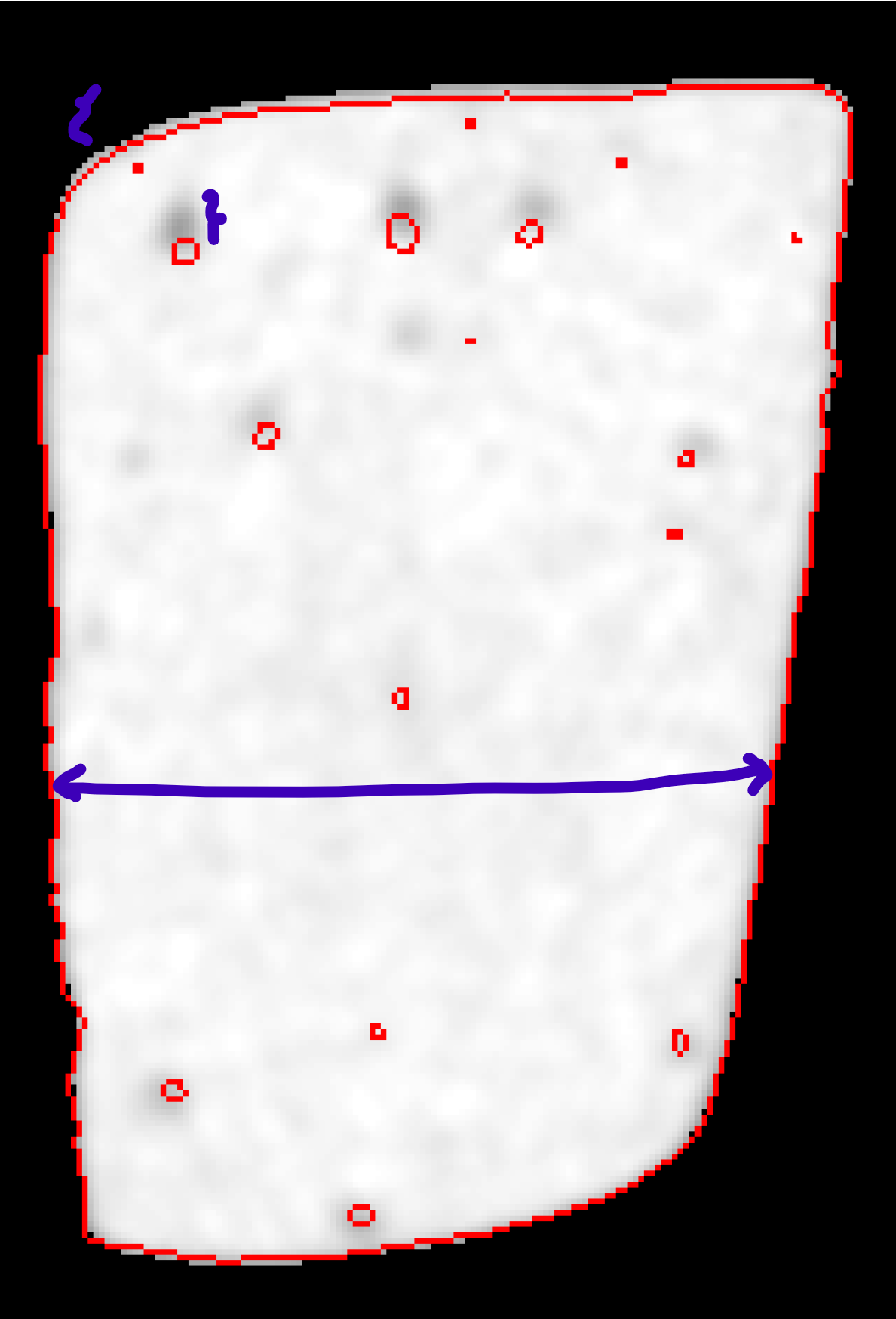
We can consider the high-res image displays the reality of the scanned specimen. I try to register these two sets of images. When I use the rigid registration I can see an offset created in one direction (fig), but when I use the non-rigid registration it matches better.
My question is:
Does the non-rigid image registration change objects’ geometry (not real anymore!)?
The following image is low-resolution and the red lines are rigid registered high-resolution (binarized)
Thank you
---
### Author:  [@zivy](https://discourse.itk.org/u/zivy)
#### Post date: [December 15, 2023, 1:46pm UTC](https://discourse.itk.org/t/does-non-rigid-registration-changes-the-real-geometry/6359/2 "2023-12-15T13:46:52Z")
Hello @Faramarz-bagherzadeh,
The answer is “it depends”. You need to incorporate domain knowledge to justify a specific transformation model. Generally speaking, you do not want to over-parameterize which will result in over-fitting. Please take a look at [this jupyter notebook](https://github.com/InsightSoftwareConsortium/SimpleITK-Notebooks/blob/e805f171ef633575486b48377db4e0715d42f63d/Python/68_Registration_Errors.ipynb) for a detailed discussion of registration errors. The most relevant section is titled **FRE-TRE, and Occam’s razor**.
Specifically to your problem:
Do you know if the sample underwent deformation between the two scans? If yes, then using a non-rigid transformtaion makes sense. Even a static object that contains water may deform if there is water evaporation. If this is the same object in both scans, no deformations, use a rigid transformation.
One last recommendation, use the high resolution (smaller voxel spacing) image as the fixed image in registration.
---
### Author:  [@lassoan](https://discourse.itk.org/u/lassoan)
#### Post date: [December 16, 2023, 5:42am UTC](https://discourse.itk.org/t/does-non-rigid-registration-changes-the-real-geometry/6359/3 "2023-12-16T05:42:25Z")
> [@zivy](#):
>
> One last recommendation, use the high resolution (smaller voxel spacing) image as the fixed image in registration.
This is interesting. Can you explain what is the advantage?
In general, I would chose fixed/moving based on what direction I need the use the transform the most. It this does not matter (e.g., because I use a rigid transform) then I would use the sparser (lower-resolution) image as fixed because then I don’t need to interpolate between sparse samples. In the extreme of single-slice to volume registration we could not even find enough samples if the dense image was used as fixed image and the sparse (single-slice) image was used as moving image.